Using a Premier League Teams Map to Dominate FPL
Using a Premier League Teams Map to Dominate FPL
Alright, let's cut to the chase. Stop just reading the fixture list and start seeing it. While your mini-league rivals are staring at a simple Fixture Difficulty Rating (FDR), the elite FPL managers—the ones chasing those top 10k finishes—have a secret weapon: a premier league teams map. This isn't a geography lesson; it's a tactical tool that uncovers hidden advantages you'd otherwise miss.
Your New Secret Weapon in FPL
The vast majority of FPL managers make their transfers based on a flat, one-dimensional fixture list. They see a sea of green, instinctively bring in a player, and completely ignore the crucial context a map provides. This guide will show you how to visualise the season, exposing overlooked patterns in travel fatigue and spotting explosive Double Gameweek potential before the template crowd catches on.
Think of it as adding a powerful, new layer to your analysis. It helps you spot which teams are primed for a run of clean sheets and which strikers might have heavy legs after a long coach journey up the country. This is your first step to thinking two gameweeks ahead of your rivals and avoiding those painful red arrows.
Uncovering Regional Clusters
The Premier League isn't spread evenly across England; it's a collection of dense clusters and a few isolated outposts. Getting a handle on these geographical groups is the first step to making the map work for you.
- The North-West Powerhouse: Home to giants like Man City, Man United, and Liverpool, this area is a hotbed of FPL assets. They have frequent, low-travel local derbies which can be a real plus when navigating fixture congestion.
- The London Congestion: A huge chunk of the league is based in and around the capital. This means minimal travel for London derbies, giving those teams a massive advantage during packed schedules. These are the teams you target when a Blank Gameweek is followed by a quick turnaround.
- Coastal and Midland Clubs: Teams like Newcastle, Brighton, and Bournemouth face consistently longer journeys. This creates predictable fatigue points in their season that you can plan around—or more importantly, target against.
This concept map shows you exactly how a geographical view connects the dots between key FPL planning elements like fixture clusters, travel impact, and those all-important Double Gameweeks.

The main thing to grasp here is that these factors aren't isolated. They're all interconnected, and the map is the tool that finally brings them all together in a way that generates green arrows.
To put it simply, looking at where teams are located gives you a massive leg-up. Here's a quick breakdown of what to watch for.
Key Regional Clusters and FPL Implications
| Regional Cluster | Key Teams | Core FPL Implication |
|---|---|---|
| The North-West | Man City, Man United, Liverpool, Everton | High asset concentration. Short travel for local games can mean less "Pep Roulette" and more explosive hauls. |
| London | Arsenal, Chelsea, Spurs, West Ham, Fulham, Crystal Palace, Brentford | Minimal travel fatigue for London derbies. Prime targets during congested periods like December. Ideal for DGW planning. |
| Midlands | Aston Villa, Wolves, Nottingham Forest, Leicester City | Central location means less extreme travel overall, but they can still rack up the miles against coastal teams. |
| Outliers | Newcastle, Brighton, Bournemouth, Southampton | Consistently long travel times. Target their opponents after a gruelling away trip or be wary of captaining their players. |
Understanding these clusters is the key to predicting which teams will have it easy and which ones are in for a punishing run of fixtures, regardless of what the FDR says.
Integrating with Your FPL Tools
This isn't just theory; it's about applying this to your weekly decisions using proper data-driven tools. The insights you get from the premier league teams map should directly inform your transfer plans and, crucially, your captaincy choices.
The difference between a top 100k finish and a top 10k finish often comes down to exploiting these marginal gains. A player with two home games in a Double Gameweek is gold; a player with two 300-mile away trips is a trap that the map helps you avoid every single time.
Ultimately, this geographical data becomes truly powerful when you combine it with real-time FPL analytics. You can track everything from your live rank to bonus point projections by checking out the fantastic tools over on Live FPL. This lets you see the immediate impact of your map-based decisions as the gameweek unfolds.
How Travel Fatigue Predicts FPL Upsets
We’ve all been there. A top-six side is playing a team circling the relegation plughole, and it looks like the easiest captaincy pick of the season. But the veterans—those managers chasing the top 10k—are looking past the obvious. They're pulling up the premier league teams map and seeing a classic trap in the making.
Think about it: a Tuesday night slog from Brighton all the way up to Newcastle is a world away from a 30-minute bus ride across London for a derby. Your gut tells you it matters, and the underlying numbers back it up. Long-haul travel, especially on a quick turnaround, almost always means tired legs, surprise rotation, and defences that are just a little bit more generous. This is the kind of hidden insight that separates the good FPL managers from the great ones.

Quantifying the Travel Tax
You can almost think of it as a "travel tax" on a team's performance. While the precise data is kept under wraps by club analysts, the anecdotal evidence is overwhelming. A team's xG (Expected Goals) almost always dips after a round trip of over 500 miles, especially when it’s for a midweek game.
It’s not hard to see why. Sleep patterns are disrupted, crucial hours are spent on a coach instead of the training pitch, and there's a real mental drain. On the pitch, that might translate to a defender being a split-second late to a tackle or a striker snatching at a chance. For us, that’s the brutal difference between a clean sheet and a goal conceded, or an assist and a frustrating blank.
When you hear a manager like Pep Guardiola complaining about the schedule, don't just brush it off as mind games. He's literally handing you FPL gold. He's telling you his players are at risk of rotation, and that’s information you can act on before the casual managers even realise what’s happening.
Turning Fatigue into FPL Points
This isn't a fun theory; it's about making cold, hard decisions that push your overall rank up. The map becomes your secret weapon for spotting these "schedule losses" before they happen.
Here’s how you can turn this knowledge into points:
- Captaincy Targeting: Is your premium midfielder playing a team that just got back from a gruelling Monday night trip to the other side of the country? Their defence is likely to be knackered. This is the perfect time to give your star the armband, banking on a haul against a tired backline.
- Benching High-Value Defenders: That usually nailed-on £5.5m defender could be a major risk if his team has just played two long away games in a week. The chances of them conceding shoot right up. Your cheap £4.0m sub, playing at home, could easily outscore him.
- Spotting Differential Punts: Flip the logic. Look for attackers on teams that have had a quiet week at home. If their opponents are the ones who have been racking up the motorway miles, they become fantastic differential picks that the template team will completely overlook.
This strategy forces you to look beyond the simple fixture difficulty colours. A fixture that looks "green" on paper can quickly turn into a banana skin once you factor in a long coach journey. By using the premier league teams map, you stop reacting to what happened last week and start proactively exploiting the vulnerabilities the schedule creates. It’s a simple shift in mindset that will keep you one step ahead of the curve.
Mapping Out Double Gameweeks for Maximum Points
Double Gameweeks. They're the moments that can make or break an FPL season. These are the weeks where your Overall Rank can skyrocket, turning a screen full of red arrows into a beautiful sea of green—but only if you get your planning right. Using a premier league teams map is what separates a blind gamble from a calculated, surgical strike.
It's one thing to see that a team plays twice. That's the easy part. The real advantage comes from seeing where those two matches are. A Double Gameweek with two home games, or maybe two local clashes with hardly any travel, is absolute FPL gold. That’s the kind of setup that screams "Triple Captain me!"

On the flip side, a team facing two draining away trips in just a few days is a classic FPL trap. Their star players are suddenly at high risk of being rested, and their defence is much more likely to look knackered and concede. This is where the map becomes your best friend, helping you sidestep the landmines that your mini-league rivals are about to walk straight into.
Spotting High-Potential Double Gameweeks
Think of the map as an instant quality filter for good and bad doubles. As soon as the fixture list throws up a DGW, your first instinct should be to pinpoint those two stadiums.
The Dream Ticket: A team playing at home twice. This is what we all hope for. Maximum rest, the comfort of their own ground, and two rounds of home support. These are the players you should be bending over backwards to get, even if it means taking a hit or using your Free Hit chip.
A Solid Bet: One home fixture and a short away trip. Think of a London derby or a North-West showdown. The travel is negligible, the routine isn’t disrupted, and the players can keep their momentum going. This is still a fantastic captaincy option.
The Obvious Trap: Two long-haul away fixtures. Imagine a team like Brighton having to trek up to Newcastle and then over to Manchester in the same week. The sheer mileage involved makes their key players a huge rotation risk. Steer clear.
FPL Travel Distance Impact Analysis (Sample)
This table shows a hypothetical look at how travel might correlate with performance. It's not just about the distance; it's about the fatigue and disruption that long trips can cause, which often translates into weaker defensive showings on the road.
| Team | Away Trip Distance (Round Trip, miles) | Opponent | xG Conceded (xGC) | Result |
|---|---|---|---|---|
| Team A | 600 | Man City | 2.8 | 3-0 Loss |
| Team B | 45 | Arsenal | 1.1 | 1-1 Draw |
| Team C | 550 | Newcastle | 2.4 | 2-1 Loss |
| Team D | 15 | Chelsea | 0.9 | 0-1 Win |
While this is just a sample, the pattern is a common one. Shorter trips often lead to fresher legs and tighter defensive performances, which is crucial information when you're deciding which DGW defenders or goalkeepers to bring in.
The Knock-On Effect on Blanks and Doubles
The map is also a brilliant tool for getting ahead of fixture rearrangements. When cup runs cause league games to be postponed, the map gives you a solid clue as to when they might be rescheduled, creating the very Double Gameweeks we all crave.
A postponed match between two London clubs, for instance, is far easier for the schedulers to squeeze into an empty midweek slot than a fixture that requires a team to travel the length of the country. By seeing these potential logjams visually, you can start building your chip strategy weeks in advance, zeroing in on the teams most likely to have a pile-up of games later on.
The real skill in FPL isn't just reacting to a DGW announcement; it's anticipating it. When a team has a run of fixtures within a 50-mile radius, their players are not only well-rested but primed to build momentum. That’s the signal to triple up before the crowd catches on.
This forward-thinking approach is what separates the top 1% from everyone else. It’s about using every bit of information available, and geography is a hugely powerful data point that most managers ignore. For a deeper look at the numbers behind player scores, especially in these massive gameweeks, see how Live FPL tracks bonus points in real-time. It’s the perfect companion for planning your DGW assault.
Tying the Map into Your Live FPL Toolkit
Having a great theory in FPL is one thing, but if it doesn't translate into actual points, what's the use? It’s all well and good spotting potential travel fatigue, but if you don’t act on it, you’re just leaving points on the table. This is where we bridge the gap between the map's geographical insights and your week-to-week FPL management.
Think of it as a one-two punch. The map flags the teams that might be feeling the strain from a long bus journey. Your FPL tools then let you zoom in, monitor the situation as it unfolds, and make a decisive move. It’s a simple but effective process that most of your mini-league rivals are probably overlooking completely.
From Map Insight to Live Action
Let's imagine a typical scenario. You've used the map to spot a team facing a nightmare travel schedule—maybe a long haul up to Newcastle followed by another tricky away day down south. The rest of the FPL world, the "template," is happily holding their popular £5.5m defender from that very team. You, on the other hand, are hunting for cracks.
This is your cue to fire up a tool like Live FPL. As the match kicks off, you can keep a close eye on that player’s live Bonus Points System (BPS) data. Is he making fewer tackles? Is his BPS baseline looking a bit shaky? These are the subtle tells—the early warning signs that fatigue might be setting in.
At the same time, you can pull up that player’s Effective Ownership (EO). If you see his EO is sky-high in your mini-league, swapping him for a well-rested alternative becomes a hugely powerful differential move. It’s the kind of decision that can send you flying up the ranks.
Here’s a snapshot of what it looks like to track your mini-leagues in the heat of the action.
This view gives you instant feedback, showing you exactly how your map-inspired hunches are impacting your overall rank and mini-league position as the goals, assists, and clean sheets roll in.
Getting Ahead with the Transfer Planner
The real magic happens when you start thinking a few moves ahead. The map isn't just for a one-week punt; it's a genuine long-term strategy tool. Spot a team with a lovely run of three or four home games coming up, or a string of local derbies with minimal travel? That’s your goldmine.
A static map is just a picture. But a map combined with a transfer planner becomes a dynamic weapon. It's the difference between hoping for a green arrow and actively building one.
By using a transfer planner alongside your map analysis, you can start plotting your moves 3-4 Gameweeks down the line. You can line up the transfers to bring in that team's star attacker or reliable defender right before their fixtures turn brilliant.
This proactive approach means you get in on players before the price rises and before everyone else jumps on the bandwagon. You maximise your points, boost your team value, and stay one step ahead of the curve. It’s what the elite FPL managers do, week in, week out.
A Case Study: The North-West Powerhouse
Theory is one thing, but putting it into practice is what earns you those coveted green arrows. So, let’s drill down on the most geographically packed—and arguably most critical—region on the Premier League teams map: the North-West. This is the home of giants like Man City, Man United, Liverpool, and Everton, making it a constant hotbed for elite FPL assets.
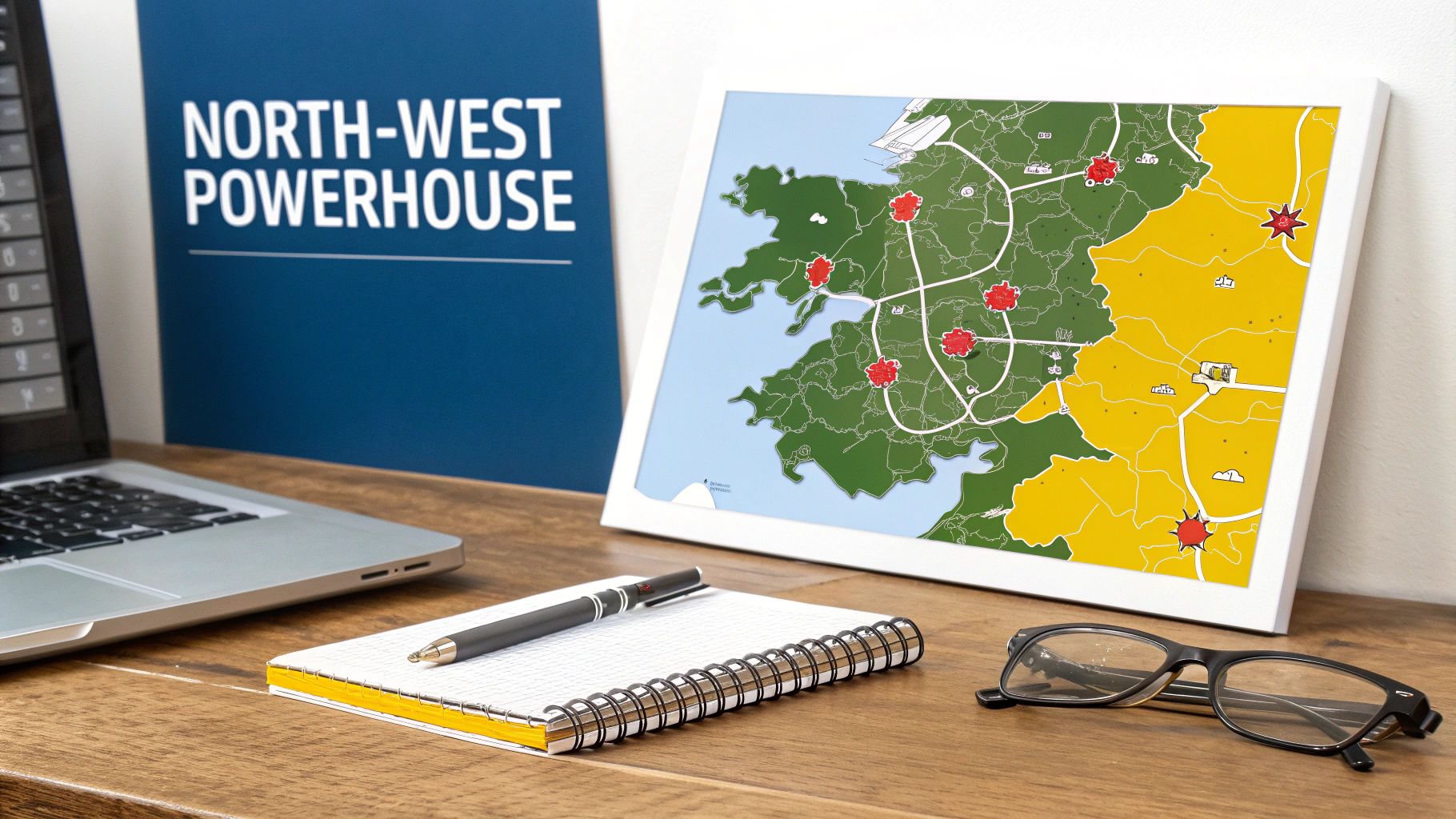
This tight cluster of clubs creates unique FPL situations that a sharp manager can exploit. For instance, picture a team playing Liverpool away at Anfield, immediately followed by another away trip to Man City at the Etihad. The travel demand is next to nothing.
Their players stay fresh, training routines aren't disrupted, and it’s a perfect setup to build momentum. This is exactly the kind of fixture run that should make their key players priority transfer targets.
Analysing the Derby Effect
But there’s another side to these local showdowns. The raw intensity of a Merseyside or Manchester derby can completely toss the form book out the window. These aren’t just any old fixtures; they are often chaotic, high-stakes battles that can have a huge say on FPL returns. So, how do we break this down?
We need to dig into the underlying numbers from past seasons. Does the derby chaos really lead to more yellow cards and fewer clean sheets, even for the top defences? The data often points to yes.
- Defensive Assets: The chance of a clean sheet almost always drops in these matches. The electric atmosphere can force uncharacteristic mistakes or inspire a moment of brilliance from an opponent. Suddenly, that premium £6.0m defender you own feels like a much riskier proposition.
- Attacking Assets: On the flip side, the frantic, open nature of some derbies can actually raise the ceiling for attackers. An end-to-end match might lower a team's overall xG but create a handful of high-quality chances for the main men up front.
The key takeaway is this: North-West derbies are volatile. They can be a goldmine for a differential captain if you call it right, but they can just as easily destroy your Gameweek if you just follow the crowd.
This simple example gives you a solid framework for looking at any regional cluster on the map. You spot the fixture run, weigh up the travel, and then add in the unique flavour of the local rivalries. To see how these decisions are paying off in real-time, you can always keep an eye on your progress with a Live FPL rank tracker.
When to Pounce and When to Avoid
So, when is the right time to load up on players from the North-West? Look for a run of fixtures against teams from outside the region, especially right after a tough derby week. Their minimal travel fatigue gives them a subtle edge over the rest of the league.
And when should you be more careful? Think twice before handing the captain's armband to a player in a derby unless the stats are screaming for a haul. Often, the smarter move is to target the team they play after the derby, who might be facing an opponent suffering from a physical and emotional hangover. This is the next-level thinking that pushes you up the ranks.
Common Questions About Using the Map for FPL
Right, let's get into the nitty-gritty. Bringing a new angle like a premier league teams map into your FPL thinking can seem a bit much at first, but once a few key points click, you'll see how powerful it is. These are the questions that always come up, and getting your head around them will give you the confidence to start finding those geographical edges.
This isn't about tearing up your entire strategy. Think of it as adding a clever, subtle filter that most of your rivals are completely overlooking.
How Heavily Should I Weight Travel Fatigue?
This is the big one. How much do you let a long trip for a team influence your decisions compared to the classic Fixture Difficulty Rating (FDR)?
The best way to think about travel fatigue is as a tie-breaker or a secondary metric. If you're stuck between two players with similar fixtures on paper, the one with a short trip or a home game is almost always the better FPL pick. Its real value, though, is in sniffing out potential upsets. When a top, heavily-owned team has to travel back from a tough European away game to then face a so-called "weaker" side, that’s a massive red flag the map helps you spot from a mile off.
Does This Map Strategy Affect Defensive Assets?
Absolutely. In fact, you could argue it affects them the most. A defence relies on organisation and concentration, and tired legs are the first thing to cause those to slip. That’s poison for your clean sheet points.
A team facing a couple of long away trips in a short space of time is far more likely to concede silly goals and lose that clean sheet potential, even against teams they should beat. This makes their popular assets, like that template £4.5m defender everyone seems to own, a huge rotation risk you can get ahead of.
One of the smartest plays you can make is targeting attackers who are playing against these travel-weary defences.
Can the Map Predict Fixture Rescheduling for DGWs?
Okay, so you can't predict postponements with 100% accuracy, but the map helps you make some seriously educated guesses. The logistics of rescheduling a match are a headache for the Premier League, and simple geography often dictates what’s possible.
Just think about these two scenarios:
- Easy Reschedule: An FA Cup match between two London clubs gets called off. Slotting that into a free midweek is pretty straightforward. Minimal travel, minimal fuss – a prime candidate for a quick Double Gameweek.
- Logistical Headache: A game between Newcastle and Brighton is postponed. That's a cross-country nightmare to rearrange. Finding a midweek slot that works for both clubs is much trickier, meaning that fixture could get pushed much later into the season.
By spotting these local fixture pile-ups, you can start to anticipate which teams are the most likely to get a DGW, giving you a massive head start on your chip strategy and transfer planning.
Ready to turn these insights into points? Stop guessing and start seeing the impact of every goal and assist on your rank as it happens. With Live FPL, you get live rank updates, projected bonus points, and mini-league tracking to stay one step ahead of the competition. Check your team ID now at https://livefpl.com.