How to Build a Winning Fantasy Premier League Team That Dominates Your Mini-League
How to Build a Winning Fantasy Premier League Team That Dominates Your Mini-League
Nailing your Gameweek 1 squad in Fantasy Premier League is less about picking your favourite players and more about building a well-oiled machine designed for points. The best managers know this. They craft a balanced squad of premium heavy-hitters, budget-friendly enablers, and a few high-upside differentials. It's a calculated effort to squeeze every last drop of value from your £100.0m budget to get off to a flying start.
Your Gameweek 1 Squad Blueprint
The team you build before a ball is even kicked is the single most important one of the entire season. Get it right, and you've got a massive head start. Get it wrong, and you're immediately playing catch-up, probably burning that precious first Wildcard just to put out fires. This is where you need to be ruthless—forget club loyalty. Your only mission is to load up on players with the best blend of form, favourable fixtures, and solid underlying numbers.
The first big question is always about structure. Over the years, two formations have consistently proven to be the most effective: the 3-4-3 and the 3-5-2.
- A 3-4-3 is your classic aggressive setup. It gets three forwards onto the pitch, which can be dynamite when there are plenty of in-form, high-value strikers to choose from. The trade-off is often having to sacrifice a premium player in midfield.
- The 3-5-2 is what most seasoned managers favour right now. This structure lets you stack your team with high-scoring midfielders—who historically offer the best points-per-million value—while still leaving room for two top-tier strikers up front.
This handy visual gives you a solid idea of how your budget might be split across these two popular formations.
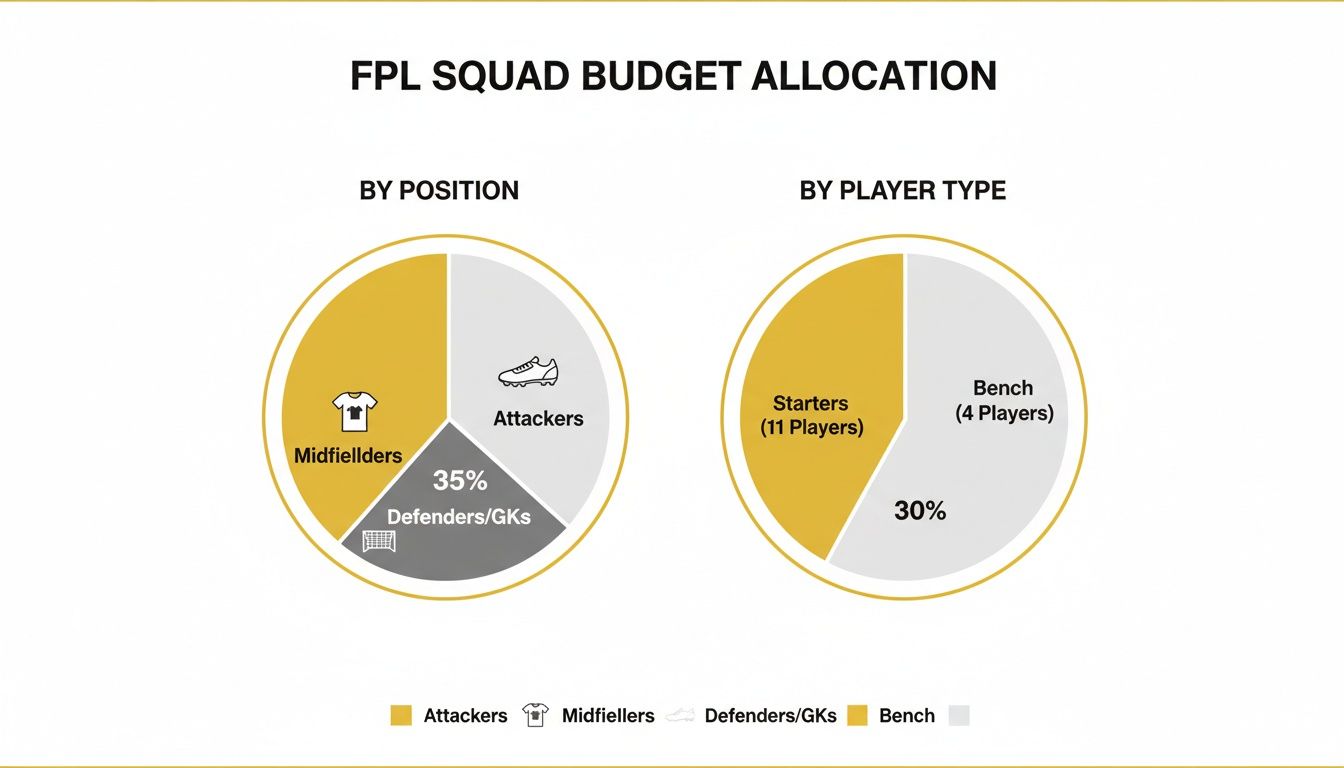
As you can see, a huge chunk of your cash—often well over 50%—is going to be tied up in your midfield and attack. That's exactly where it should be, as these are the positions that produce the monster, captain-worthy hauls.
The Budget Allocation Blueprint for a £100.0m Squad
To help you visualise this, here’s a table outlining a typical budget spread for a £100.0m squad. This isn't a rigid rule, but it's a fantastic starting point for mapping out your fantasy premier league team.
| Position | 3-4-3 Formation Allocation | 3-5-2 Formation Allocation | Key Consideration |
|---|---|---|---|
| Goalkeepers | £8.5m - £9.0m | £8.5m - £9.0m | One premium keeper or two rotating budget keepers. |
| Defenders | £22.5m - £24.0m | £23.5m - £25.0m | Mix of attacking full-backs and nailed-on starters. |
| Midfielders | £33.0m - £36.0m | £39.0m - £42.0m | The engine room; this is where value is often found. |
| Forwards | £32.0m - £35.0m | £25.0m - £28.0m | Premium assets here cost a significant chunk of your budget. |
Think of this as your financial blueprint. Adjust it based on where you see the best value in any given season, but stick to the general principle of investing heavily in attack.
Finding Balance and Value
A successful FPL team isn't just about jamming in superstars like Haaland and Salah and hoping for the best. You need a finely tuned mix of price points to create a squad that actually functions. The golden rule here is to find players who are "nailed-on"—that is, they are virtually guaranteed to start every week. This is absolutely critical for your cheaper players; a £4.5m defender sitting on the bench is a completely wasted slot.
A strong bench is non-negotiable. Aim for at least one, ideally two, playing substitutes. This is your insurance policy against last-minute injuries and the dreaded 'Pep Roulette'. A non-playing bench will cost you dearly over 38 gameweeks.
When you're digging for differentials, look past the basic goals and assists. The real edge comes from looking at the underlying data. A player who consistently posts high xG (Expected Goals) and xA (Expected Assists) is getting into the right positions, and it's only a matter of time before the hauls flow.
It’s also smart to identify "BPS magnets"—players who hoover up bonus points from actions like making key passes or winning tackles. You can dive into a detailed breakdown of the Gameweek 1 bonus points to get a feel for who regularly tops up their scores. This is how you unearth those differentials that your mini-league rivals have completely missed.
Mastering Transfers and Building Team Value
Your Gameweek 1 squad is just the starting block. The real art of FPL—what truly separates the top 10k managers from the rest of the pack—is mastering the transfer market. This is so much more than just swapping out an injured player. It's about being proactive, staying ahead of the price changes, and ruthlessly targeting those crucial fixture swings.
Winning FPL managers are always thinking two or three Gameweeks ahead. They aren't just reacting to last week's points; they're trying to predict who is going to haul next. This means spotting teams with a lovely run of green fixtures on the horizon and getting their key players in before the crowd does. Get in early, and you not only bank their points but also build that all-important team value as their price shoots up.
When to Take a Hit and When to Roll
We’ve all been there. After a disastrous Gameweek, the temptation to rip your team apart and make a raft of changes is overwhelming. But panic is the single biggest killer of a good FPL season. A -4 point hit needs to be a calculated investment, not a knee-jerk reaction born out of FOMO.
Before you confirm that transfer, ask yourself one simple question: will the player I’m bringing in realistically outscore the player I’m selling by at least four points over the next couple of Gameweeks? If you can confidently say yes—maybe you're swapping a benched player for a team's main penalty taker who's about to face two leaky defences—then the hit makes perfect sense.
On the flip side, learning to roll a transfer is one of the most powerful skills you can develop. Banking a free transfer means you have two to play with the following week. This gives you incredible flexibility to deal with injuries, suspensions, or a surprise Double Gameweek announcement. It's your get-out-of-jail-free card.
Never chase last week's points. It's fantastic that a player scored a hat-trick, but if their underlying stats (like xG) are poor and their next three opponents are tough, you've almost certainly missed the boat. Always trust the underlying numbers and the fixtures, not the hype.
Building Team Value is a Long-Term Weapon
Think of team value as your secret weapon for the business end of the season. Every single £0.1m you earn in price rises is extra spending power your mini-league rivals might not have. Come a big DGW in February, having an extra £1.0m or £2.0m in the bank can be the difference between snagging a must-have premium forward and having to settle for a budget alternative.
So, how do you actually build it?
- Act Early: Don't dither until the Friday night deadline. If a player is on fire and has huge ownership traffic, get them in before their price rises, which typically happens on a Tuesday or Wednesday night.
- Target Bandwagons: This is one of the few times where following the herd pays off. Jumping on players who are performing well and being transferred in by tens of thousands of managers is a sure-fire way to catch those price increases.
Remember, FPL is a marathon, not a sprint. Smart, patient, and proactive transfer management will give your fantasy premier league team the edge it needs to climb the ranks and dominate your mini-leagues. Stay calm, trust the numbers, and always be thinking ahead.
Nailing Your Captaincy and Chip Strategy
Getting your captaincy choice right is the single most powerful thing you can do each week. It's the decision that can single-handedly turn a miserable gameweek into a season-defining green arrow. The best FPL managers don't rely on gut feelings; they use a cold, calculated approach, balancing form, fixtures, and those crucial underlying numbers.
A player might have scored a brace last week, but the eye test is only half the story. You need to be diving into stats like shots in the box, big chances, and xG (Expected Goals) to see if that performance was repeatable. A high-volume shooter with a great fixture at home is almost always the smarter, higher-upside pick than a player who just got lucky once.
The Effective Ownership Conundrum
This leads us to the critical concept of Effective Ownership (EO). This metric shows what percentage of managers will benefit when a player hauls, factoring in captaincy and even the Triple Captain chip. If a player like Haaland has an EO of 180%, it means not captaining him when he scores is a guaranteed way to see red arrows.
You really only have two choices here:
- Play it safe: Go with the crowd and captain the obvious, highly-owned player. This is a defensive move that protects your rank. You won’t lose ground on the masses if they deliver.
- Go differential: Back a less-popular captain. This is pure high-risk, high-reward. It can catapult you up the rankings if it pays off, but it'll tank your week if it backfires.
This screenshot from Live FPL shows exactly how you can track EO for your mini-league rivals in real-time. It gives you a crystal-clear picture of the risks and rewards of your armband choice before the deadline even passes.
The data here reveals just how exposed you are to a rival's captain, helping you decide whether to stick with the template or gamble on a differential.
A Game Plan for Your Chips
Beyond the weekly captaincy drama, your chips are the trump cards you play to gain a massive advantage. Using them correctly is crucial, and believe me, timing is everything.
Resist the temptation to use your chips early. The biggest Blank and Double Gameweeks (BGWs and DGWs) almost always fall in the second half of the season. Patience is your greatest ally here; a well-timed Bench Boost in a DGW can easily be worth over 100 points.
Here’s a simple framework I stick to for deploying them:
- Wildcard: The first one is perfect for fixing early-season mistakes, usually around Gameweeks 4-8, to jump on fixture swings. Save the second one to set up for a huge Double Gameweek later on.
- Triple Captain: Save this for a premium player with two juicy fixtures in a Double Gameweek. Don’t waste it on a single gameweek, no matter how tempting the fixture looks.
- Bench Boost: This is the ultimate DGW weapon. The classic move is to Wildcard the week before, loading your squad with 15 double-gameweek players, then unleashing the boost for maximum points.
- Free Hit: The perfect solution for a big Blank Gameweek where half your squad doesn’t even have a match.
Mastering your captaincy is a proven path to the top. Just look at the Dutch FPL managers, who have a reputation for dominating their leagues by consistently getting these big calls right. In the 2023/24 season, 73% of the top 100 managers in the Netherlands captained players who delivered double-digit hauls at least eight times. You can dive into more detailed numbers yourself at Fantasy Football Pundit to make sure your armband choices are always backed by data.
The Underrated Art of Picking Defenders

There's an old cliché in football: strikers win you games, but defenders win you titles. Funnily enough, the same holds true in FPL. While your captaincy choice gets all the attention and glory, it’s a rock-solid defence delivering steady returns that truly forms the foundation of any top-ranking team.
Getting your backline right is an art form, one that most casual managers completely overlook. Too many FPL players just default to picking defenders from the "big six" clubs and hope for the best. That’s a decent starting point, but it often means you're overpaying for players who are just as likely to concede a sloppy goal as anyone else. The real edge comes from unearthing those budget-friendly gems who offer a perfect mix of clean sheet potential, attacking upside, and bonus point magnetism.
Exploiting Fixtures with a Rotation Strategy
One of the most powerful, yet strangely underused, strategies for your backline is setting up a rotation pair. This means picking two cheap defenders—usually in the £4.0m to £4.5m bracket—from teams whose fixtures complement each other perfectly.
The goal is simple: you want their schedules to alternate so that one of them almost always has a favourable home fixture. You just bench the one with the tough away game and play the one at home, dramatically boosting your chances of a clean sheet. This clever "set-and-forget" tactic can free up millions in your budget to splurge on those heavy-hitting midfielders and forwards.
A fantastic example of the kind of budget asset that top managers hunt for is a busy goalkeeper on a team that faces a lot of shots but isn't a total defensive shambles. Historically, an analysis of top finishers revealed that 68% owned at least two Brighton assets. Think of a keeper like Bart Verbruggen: his £4.5m price tag delivered a massive 103% value return, hitting 2.9 points per game with 91 saves by mid-season. Those saves alone can push a player up the bonus point predictions, helping managers climb the live ranks. You can dig into detailed stats to find similar bargains over at FPL Form.
Your defence isn't just about stopping goals. Wing-backs who bomb down the flank to whip in crosses or centre-backs who are a menace on set-pieces give you multiple ways to score points. A defender who finds the back of the net is worth their weight in gold.
To see this in action, imagine you've paired a defender from a team like Crystal Palace with one from Fulham. Their fixture schedules might line up something like this over a specific period:
Example Defensive Rotation Pair (Weeks 5-10)
| Gameweek | Team A Fixture (Player 1) | Team B Fixture (Player 2) | Selected Player |
|---|---|---|---|
| 5 | Home vs Wolves | Away vs Man City | Player 1 |
| 6 | Away vs Aston Villa | Home vs Nottm Forest | Player 2 |
| 7 | Home vs Everton | Away vs Chelsea | Player 1 |
| 8 | Away vs Spurs | Home vs Sheffield Utd | Player 2 |
| 9 | Home vs Burnley | Away vs Liverpool | Player 1 |
| 10 | Away vs West Ham | Home vs Bournemouth | Player 2 |
By simply switching between these two budget players, you can ensure a run of winnable home games, which is the holy grail for clean sheets. It's a simple, effective way to maximise points from your cheapest players.
Unlocking the Bonus Points System
The real secret to squeezing every last point out of your defenders lies in understanding the Bonus Points System (BPS). A clean sheet is a lovely four points, but those extra one, two, or even three bonus points are what really separate the top managers from the rest. Defensive actions like clearances, blocks, and interceptions (CBI) all feed directly into a player’s BPS score.
This is where the term "BPS magnet" comes from. These are the defenders who, even on a day when their team concedes, rack up so many defensive actions that they still sneak into the bonus points. They are the grinders, the players who consistently deliver a steady stream of returns that your mini-league rivals are probably missing out on.
If you want an elite fantasy premier league team, stop thinking of defenders as an afterthought. Start building a backline that combines attacking threat, smart fixture rotations, and BPS potential. That’s how you turn your defence from a necessity into a consistent source of those beautiful green arrows.
Using Live Data to Gain a Real-Time Edge
The official Fantasy Premier League site is brilliant, but it has one major drawback: points only update after the final whistle. By then, the damage is done, or the glory is sealed. Elite FPL managers don't wait; they operate in the now, reacting to the ebb and flow of a gameweek as it unfolds. This is where you can gain a massive advantage over your rivals—by using live data to turn real-time events into actionable intelligence.
Waiting until Sunday night to see how your team did is a rookie move. The top-tier managers are plugged into the live data stream, watching their rank fluctuate with every goal, assist, and yellow card. It’s an entirely different way to experience FPL, transforming you from a passive observer into an active analyst.
Track Your Rank and Rivals in Real Time
Picture this: your captain has just blanked, and you're feeling the pain. But then, a defender you left on your bench scores a rare goal. Most managers won't know the true impact of this until hours later. You, however, can see your live overall rank (OR) jump instantly, turning a potentially disastrous moment into a net gain.
That's the power of live rank tracking. Instead of guessing, you get a precise, minute-by-minute picture of your progress. This is especially potent in mini-leagues. You can monitor your rivals' teams as the action happens, seeing exactly how that surprise goal from their differential striker affects your head-to-head battle. It gives you a crystal-clear picture of what you need from your remaining players.
A fantastic tool for this is Live FPL. Just pop in your team ID—no registration needed—and you get instant updates.
The Power of Live Bonus Points
Clean sheets and goals are the bread and butter of FPL, but it's often those crucial bonus points that decide mini-league titles. The official site only calculates these after the match, but live tools can project them in real-time based on the Bonus Points System (BPS).
This screenshot from a live league tracker shows how you can monitor bonus points for every player as the matches unfold.
As you can see, you get more than just the raw points. You know which players are currently sitting on 3, 2, or 1 bonus points, giving you a vital edge in understanding the true final scores long before they're confirmed.
Knowing a player is on for maximum bonus can completely change your perspective on a gameweek. For instance, if your differential defender is on track for three bonus points, you know you’re getting a significant boost that others might not see coming. On the flip side, seeing your captain drop out of the bonus can temper your expectations and help you plan your next move with a clearer head.
By monitoring live Effective Ownership (EO), you can immediately understand the impact of a major event. When a 150% EO player scores, you'll see your rank hold steady. But when your 5% owned differential finds the net, you can physically watch the green arrow grow in real-time. This is what it feels like to be ahead of the curve.
This real-time feedback loop is what separates the casual player from the serious manager. It removes the guesswork and replaces it with hard data, allowing you to make smarter, faster decisions. Stop waiting for the official update; start managing in the moment and give your team the competitive edge it deserves.
Your Most Common FPL Questions Answered

No matter how many seasons you've played, some FPL dilemmas just never go away. Every manager, from the seasoned veteran to the "Top 10k" chaser, wrestles with the same key decisions. Let's get straight to it and tackle some of the biggest questions you'll face when putting together your fantasy premier league team.
How Many Premium Players Should My Team Have?
There's no golden rule here, but a solid, balanced team usually centres around two or three premium picks—those players priced at £10.0m or more. A very popular and effective structure is to have one top-tier forward (think Haaland) and then one or two elite midfielders (like Salah or Saka).
This strategy gives you fantastic captaincy options from the league's most reliable point-scorers. Crucially, it also leaves you with enough budget to build a decent squad around them, including playing enablers on your bench. Going all-in with four or five premiums might look tempting on paper, but it often leaves your bench threadbare and makes your team incredibly brittle when injuries and rotation inevitably hit.
When Is the Best Time to Use My Wildcard Chip?
Patience and planning are everything when it comes to the Wildcard. For your first one, there are two classic windows to aim for. The first is early on, somewhere between Gameweek 4 and 8. This is perfect for fixing any mistakes from your initial draft, jumping on breakout players, and targeting teams with a great run of fixtures.
Your second, and arguably more powerful, opportunity comes right before a big Double or Blank Gameweek. Playing it then lets you completely restructure your squad to load up on players with two matches, setting you up perfectly for a huge Bench Boost or Triple Captain score.
The one thing you must avoid is a "rage Wildcard"—don't burn it after one disastrous gameweek. Your Wildcard should be about a long-term plan for the next five or six weeks, not a knee-jerk fix for last week's red arrows.
How Important Is Team Value in FPL?
Team value is massively important. Seriously, don't underestimate it. Building your squad's value throughout the season gives you incredible flexibility later on. Come the business end of the season, having that extra £1.0m or £2.0m in the bank can be the difference between getting that must-have premium player or having to take a point hit to afford him.
You build value by buying players before everyone else does and their price goes up. While you should never make a transfer just for a price rise, being quick to act on in-form players is a huge advantage. Think of it as a long-term investment in your team's purchasing power. This is where real-time data helps; checking tools that show live bonus points can tell you if a player's big score was backed up by strong underlying stats, making them a more secure long-term asset.
At Live FPL, we give you the real-time data to make these crucial decisions. Track your rank, monitor rivals, and see live bonus points as they happen to gain a real competitive edge.